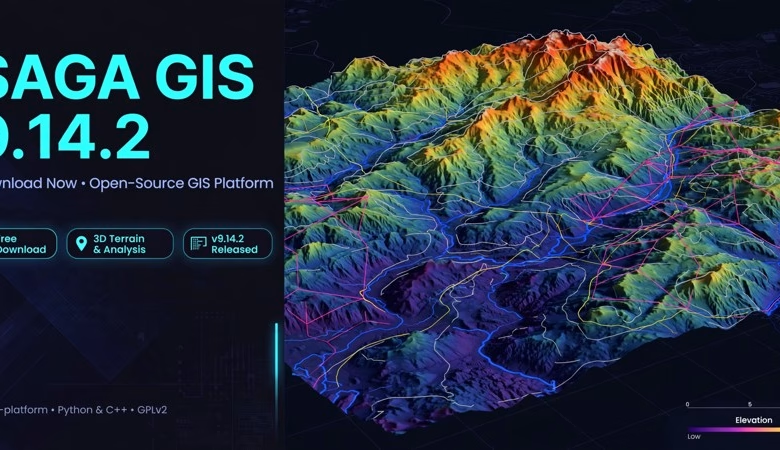
This SAGA GIS 9.14.2 free download guide gets you the newest release of the free, open-source GIS built for geoscientific work. SAGA GIS (System for Automated Geoscientific Analyses) is famous for one thing: terrain analysis from digital elevation models — slope, aspect, hillshade, watersheds, and flood modeling with zero license fees. Version 9.14.2 is a bug-fix release that follows 9.14.1, and it fixes the one thing Windows users have been feeling since version 9.13: slow drawing of polygon and line layers. Below you will find what’s new, step-by-step install instructions for Windows, Linux and macOS, system requirements, and answers to the most common questions.
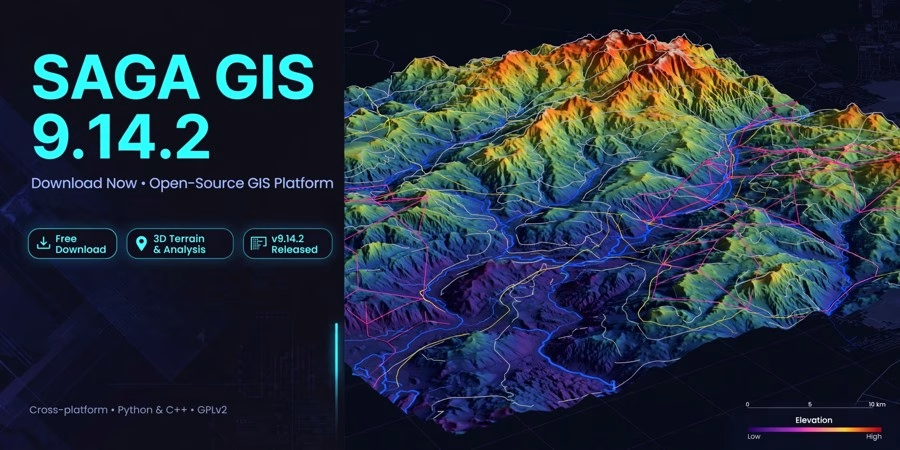
SAGA GIS 9.14.2 Download: What’s New in This Release
SAGA 9.14.2 is a focused bug-fix release, announced on the official SAGA news page on 28 October 2026. No new modules, no interface overhaul — just a performance fix that matters every time you pan or redraw a map, plus a handful of smaller fixes, taken straight from the official changelog. Here is what changed.
Much faster polygon and line drawing on Windows
The headline fix in 9.14.2 is in the map drawing code: drawing polygons and lines through the wxDC API had become enormously slow on Windows, a regression introduced with SAGA 9.13 when the wxWidgets library changed its drawing logic (starting with wxWidgets 3.3.3). If your maps with vector layers felt sluggish on Windows since 9.13, this is the release that fixes it — panning, zooming and redrawing polygon and line layers is fast again.
Map resizing stays fast with bitmap redraw
The 9.14.2 changelog also carries the map-control improvement from the 9.14.x line: when you resize a map window, SAGA redraws the bitmap instead of refreshing the whole map content. Combined with the polygon/line drawing fix, map windows on Windows now feel responsive in both directions — resizing and redrawing.
Web access can now use libcurl
The web-services module can now optionally use libcurl for web access instead of the built-in request handler, when built with wxWidgets 3.3 or newer. If you pull online data into SAGA — for example through the open-data tools — downloads are more robust on current builds.
Smaller fixes: QGIS plugin, terrain maps, gap filling
The rest of the changelog is small but real: the SAGA plugin for QGIS stays compatible with the latest QGIS Python API (version 4.3 and newer), the Grid Terrain Map transparency setting is fixed, map-shape thumbnails now draw correctly, and the Close Gaps with Spline tool now checks for data gaps in its precomputed gap-size evaluation instead of erroring out. The German open-data (DGM1) tool also gets a GUI-only parameter fix.
How to download and install SAGA GIS 9.14.2 on Windows
The easiest path on Windows is the portable zip from the official SourceForge files page — SAGA needs no installer. Go to the official download site, open the Files section, and download the saga-x64 zip for the 9.14.2 release. Unzip the folder anywhere, open it, and double-click saga_gui.exe. That is the whole installation — no admin rights needed, and it even runs from a USB drive.
How to install SAGA GIS 9.14.2 on Linux and macOS
On Ubuntu or Debian, install from your distribution’s repository or grab the build for your distro from the SourceForge Files page. A linux tarball is published for each release. macOS users can download the macOS app bundle from the same Files page. After launching, run saga_gui or open it from your app menu to verify it starts.
System requirements
| Requirement | Detail |
|---|---|
| Operating system | 64-bit Windows 10/11, Ubuntu 20.04+ or other recent Linux, macOS (bundle available) |
| Disk space | ~300 MB for the program, 2 GB+ free for DEMs and outputs |
| Memory (RAM) | 2 GB minimum, 8 GB or more for large LiDAR and DEM datasets |
| Processor | Any dual-core; quad-core speeds up module runs |
| Programming (optional) | Python 3 for PySAGA scripting |
Frequently asked questions
Is SAGA GIS 9.14.2 really free?
Yes. SAGA GIS is fully open-source under the GPL. There is no paid version, no trial, and no locked features — 9.14.2 costs nothing for students, researchers, or businesses.
What is new in SAGA GIS 9.14.2?
It is a bug-fix release: polygon and line layers now draw much faster on Windows (fixing a slowdown introduced with SAGA 9.13 and wxWidgets 3.3.3), map resizing keeps its fast bitmap redraw, web access can optionally use libcurl, and the QGIS plugin stays compatible with QGIS 4.3+.
Should I upgrade from SAGA GIS 9.14.1?
Yes — 9.14.2 is a direct patch on top of 9.14.1 with no breaking changes. If you run SAGA on Windows and work with vector layers, the drawing fix alone makes the upgrade worth it.
Do I need to install SAGA GIS?
Not on Windows — it is portable. Unzip the x64 folder and run saga_gui.exe. Linux users install it from their distro’s repository or the SourceForge files page.
Can I use SAGA GIS with QGIS?
Yes. QGIS includes SAGA algorithms in its Processing Toolbox, and both read the same GeoTIFF, shapefile, and grid formats. Many students preprocess terrain in SAGA and make final layouts in QGIS — and 9.14.2 keeps the QGIS plugin compatible with QGIS 4.3 and newer.
What is SAGA GIS used for?
Terrain analysis is its strength: slope, aspect, hillshade, watersheds, and flood or erosion modeling from elevation data. It also covers geostatistics, image analysis, and general geoprocessing — over 450 modules.
SAGA GIS 9.14.2 is a small release with an outsized everyday payoff: vector layers that draw fast again on Windows, quick map resizing, and a QGIS plugin that keeps up with QGIS 4.3. It installs in minutes on Windows, Linux and macOS, and it costs nothing. If you already run 9.14.1, this is a five-minute upgrade worth making today.
Related posts: SAGA GIS 9.14.1 Free Download · SAGA GIS 9.14.0 Free Download · GRASS GIS Software Download · QGIS Download for Windows, MacOS and Linux
Disclosure: Some links on this page are affiliate links. If you buy a book through them, CartoGeek may earn a small commission at no extra cost to you. This helps keep our GIS guides free for students. Thank you for your support!
Recommended GIS Books
Learn QGIS: Techniques for Efficient Spatial Analysis (5th Edition)
by Eugenia Sarafova, Ivan Ivanov, Andrew Cutts, Anita Graser
The most current beginner-to-intermediate QGIS book, covering spatial analysis, cartography, field data collection and earth observation workflows with real-world examples. Written with input from Anita Graser, a well-known QGIS community figure, it walks readers from first install to confident analysis.
Pros:
- Up to date with recent QGIS versions
- Hands-on, exercise-driven teaching style
- Covers modern topics like GenAI tools and mobile data collection
Cons:
- Moves fast for absolute beginners with zero GIS background
- Some advanced chapters assume basic statistics knowledge